Distinct owner and contractor roles
Separate workflows for the person commissioning work and the party proposing and carrying it out.
An owner-controlled renovation record designed to make estimates, revisions, decisions and evidence easier to understand and trace.
Active development · Public sample and website available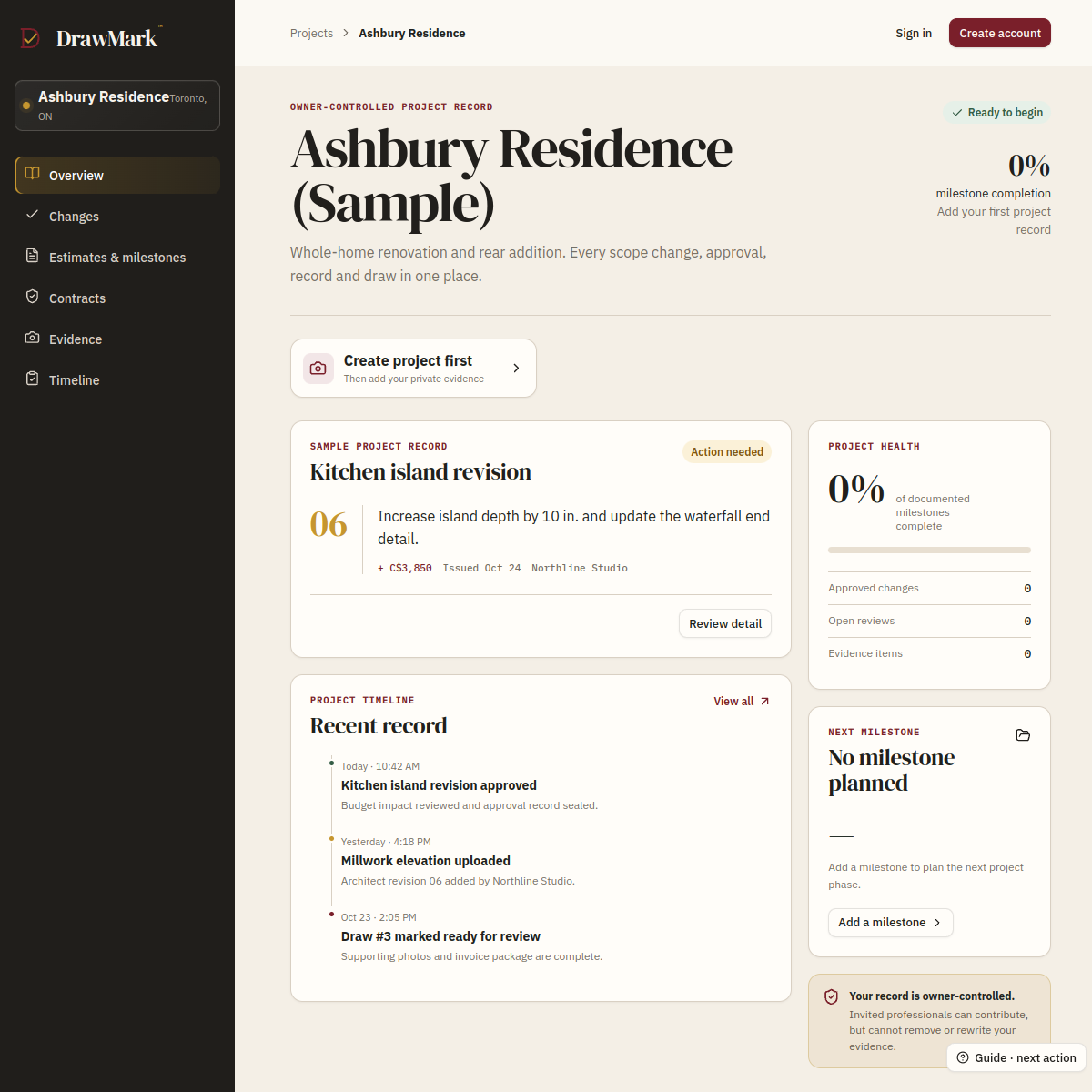
Separate workflows for the person commissioning work and the party proposing and carrying it out.
A source document is preserved while individual terms can be extracted, reviewed, clarified or rejected.
The intended flow requires explicit acceptance and clear reasons for changes rather than silently overwriting the initial scope.
Progress and supporting files are designed to remain connected to the relevant project record.
The experience aims to show one next action at a time during setup, then reveal the permanent project record once the agreement is ready.
Create the job, capture owner information and invite the relevant contractor.
Upload or prepare a scope document, preserve the source and allow the owner to review it.
Handle revisions and approvals before allowing agreement signing.
Attach milestones, photos, approvals and dated change history as the work proceeds.
When a workflow has many roles, tabs and permissions, visible complexity can trap users. Step-by-step guidance is more useful than presenting every action at once.
OCR and AI extraction can help fill fields, but original estimates and human decisions must remain the authority when numbers, taxes or clauses are unclear.
An owner may accept, reject or request revisions. Contractors need corresponding options and a reliable transition through signing and active work.
Current status: The owner/contractor end-to-end workflow is still undergoing stabilization. The public screenshot represents a sample, not proof that every proposed workflow is released or complete.
A real multi-seller trading-card marketplace where listing, collecting, paying, and fulfilling an order have to work together—not as disconnected website features.
Read case study →CASE STUDYCard Scanner APIExploring how a stack of card photographs can become organized, reviewable records while preserving image quality and acknowledging uncertain identification.
Read case study →